

The Redesign Journey of a Health Screening Cart From Fragmented Assembly to an Integrated Health Management Workstation
In the medical device industry, we often encounter projects like this—
the equipment is functionally complete, yet the overall experience does not feel like a professional medical product.
This ODM collaboration is a typical example.
The customer originally had a multifunctional medical cart integrating multiple vital-sign monitoring devices. However, during long-term use, several issues gradually emerged:
● Exposed devices and visually fragmented structures
● Disconnected workflows with complex operating steps
● Complicated installation and an unsatisfactory user experience
When the customer approached us, their request was not to “add another module,” but to pursue a complete reconfiguration—
a system-level upgrade covering structure, layout, appearance, and delivery approach.
And this is where the true value of ODM comes into play.
01.Starting Point: In-Depth Requirement Research, Not Just Design Sketches
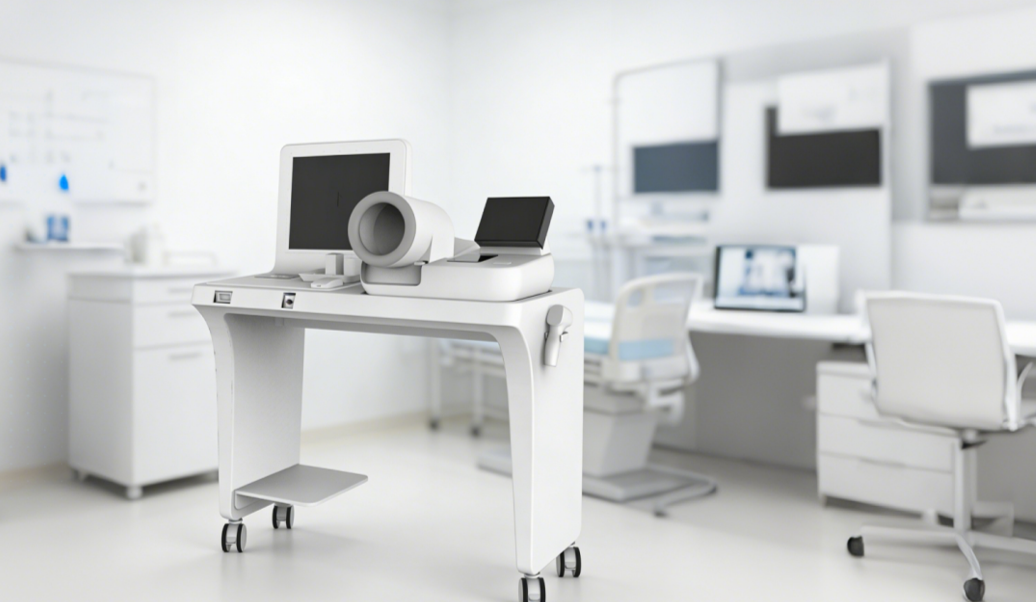
At the early stage of the project, we did not rush into design. Instead, we returned to the essence of ODM—deeply understanding real usage scenarios and uncovering genuine pain points.
Through a systematic analysis, we identified three core categories of challenges:
1️⃣ Structural level
● Devices sourced from multiple suppliers, lacking overall structural planning
● Excessive external attachments, resulting in visual fragmentation and insufficient professional appearance
2️⃣ Operational level
● Layout of screens, blood pressure monitors, barcode scanners, and other components not aligned with ergonomic workflows
● Redundant operating paths, requiring medical staff to frequently bend down or move across zones to retrieve equipment
3️⃣ Integration level
● Low utilization of storage space
● Modules functioning independently, with limited coordination and a fragmented user experience
This phase went beyond simply “listening to requirements.”
From a manufacturing and system integration perspective, we restructured the product’s underlying logic.
02.Core Principle: ODM Is Not About Adding Features, but Rebuilding Structure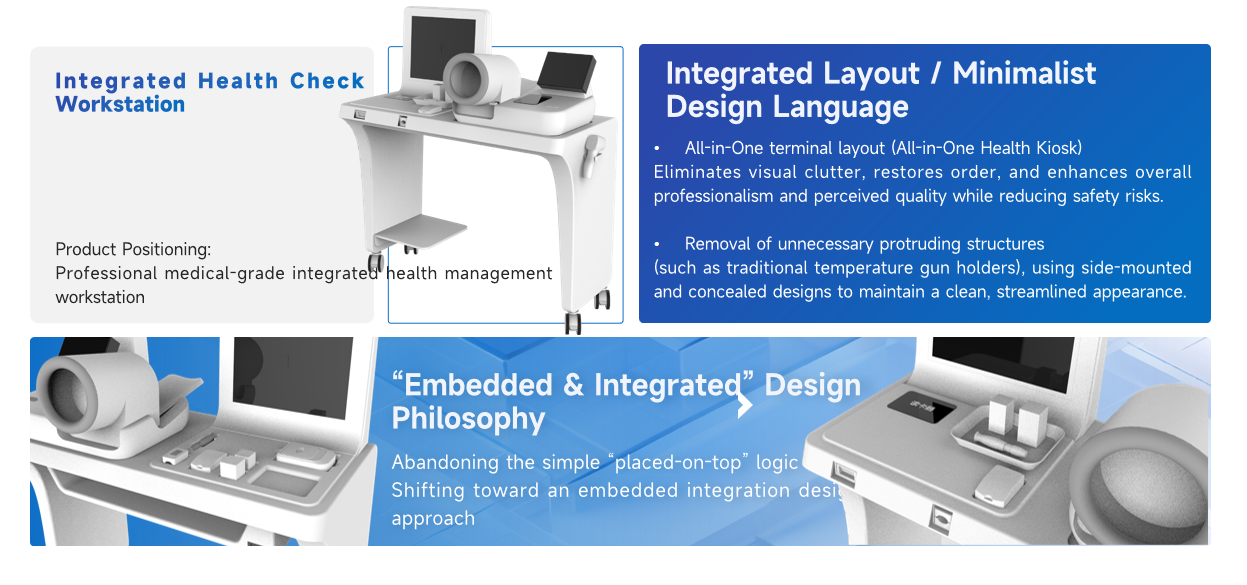
Based on the problem analysis, we defined the product positioning and design principles clearly.
Product positioning:
A professional-grade integrated health management workstation
Design keywords:
Integration | Embedded design | Minimalist | Mass-producible | Easy to deliver
We proposed a core design philosophy that guided the entire project:
a shift from “placement-based logic” to “embedded and integrated logic.”
03.Key Design Decisions: Professionalism Embedded in the Details
1)Integrated Terminal Layout
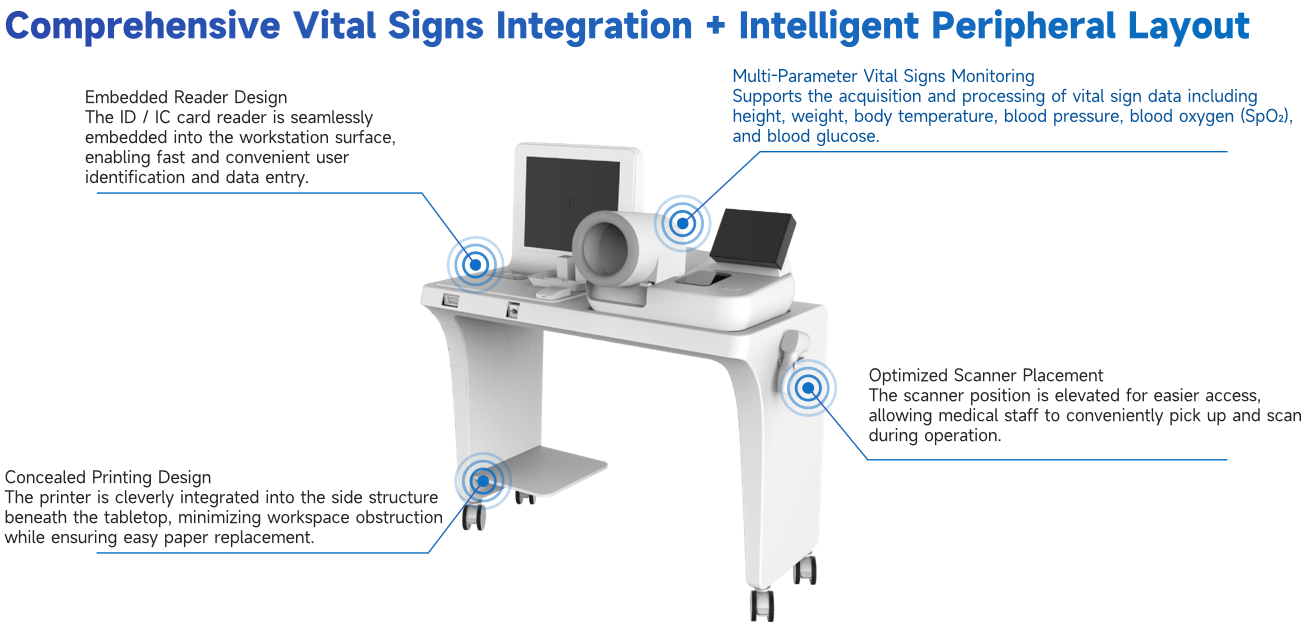
The six originally scattered measurement modules—height, weight, body temperature, blood pressure, blood oxygen, and blood glucose—were fully integrated into a unified structural framework through compatibility-focused design, rather than simple stacking or accumulation.
The results were immediately evident:
● A highly unified and cohesive appearance
● Reduced safety risks
● A significantly enhanced sense of professionalism
2)Embedded Peripheral Design
● The card reader was embedded directly into the desktop, achieving seamless integration
● The printer was concealed beneath the work surface, saving space while allowing easy paper access
● The infrared thermometer was secured via a side-mounted holder, eliminating exposed supporting structures
● The barcode scanner was repositioned to a higher level, aligning with natural reach and grip height
3)Production-Ready Optimization of the Work Surface and Storage System
● Custom recessed slots were designed for the blood pressure monitor and pulse oximeter, ensuring a flush and level work surface
● The blood glucose meter was assigned a dedicated zone, while other consumables were organized into standardized trays
● All structural components were validated through assembly and tolerance verification, ensuring readiness for scalable production
This was not just about visual design, but about laying a solid foundation for mass production.
04)Optimizing Human–Machine Interaction for Seamless Workflows

he core of ODM is not only “making it manufacturable,” but also making it intuitive to use.
After repeated validation, we made one critical adjustment: swapping the left–right positions of the display and the blood pressure monitor.
This change streamlined the key workflow:
Data entry → Blood pressure measurement → Data confirmation
With a shorter path and more natural movements, the entire interaction became smoother and more efficient.
In addition:
● The barcode scanner was repositioned higher to reduce bending
● The integrated design minimized exposed cables, reducing clutter and interference
This is a clear example of how a manufacturing team can play a deep role in product definition—turning usability insights into scalable, production-ready design.
05.From Prototype to Mass Production: Ready to Deploy, Ready to Use
With the structure and functions confirmed, we further optimized the design for delivery:
● Designed to support complete-unit packaging and transportation
● No complex on-site secondary installation required
● Significantly reduced deployment and maintenance costs for customers
Final results:
● Desktop space utilization increased by over 30%
● A substantial improvement in professional appearance and institutional trust
● Easy replication across multiple application scenarios
06.Why Choose Vision MedTech
Professional Design:
Rooted in real clinical and health screening scenarios, our design process systematically addresses operational workflows, human–machine interaction, and structural layout. Every detail is engineered around high-frequency usage by medical staff, ensuring that the integrated health management workstation is truly intuitive, efficient, and easy to use.
Quality Manufacturing:
Backed by a full-chain manufacturing system—from R&D and structural validation to mass production and delivery—we exercise strict control over key structures, assembly precision, and overall stability. This ensures long-term reliable performance under high-frequency use and complex operating environments.
Scenario Adaptability:
Designed around health management and vital-sign acquisition needs, the solution flexibly adapts to multiple application scenarios, including hospital outpatient departments, health check-up centers, community healthcare services, and chronic disease management programs—supporting requirements from basic screening to comprehensive management.
Intelligent Manufacturing:
With in-house tooling, injection molding, sheet metal fabrication, and complete assembly and testing lines working in coordination, Vision MedTech supports rapid development, scalable production, and consistent delivery of integrated health management workstations—helping customers bring projects to market efficiently.
Bringing greater order to health management. Enabling more efficient medical collaboration.
If you are looking for a highly integrated, stable, and reliable integrated health management workstation solution, we welcome you to contact Vision MedTech.
With ODM/OEM manufacturing capabilities at our core, we provide professional product consulting and deep customization services—helping you build health management equipment systems that are truly scalable and ready for real-world deployment.
Submit a request
Your name*
Mail*
Company Name*
phone
message*
File/Image Upload
Note:Up to 6 files, each within 10MVerification code