

Case Study | From a Simple Client Request to a Fully Deployable Shared Wheelchair System
Vision Technology · ODM CASE STUDY
From an Initial Idea to a Deployment-Ready Shared-Wheelchair System
From requirements analysis and product definition to mechanical design and on-site deployment, this case study shows how Vision Technology transformed an early-stage concept into a smart shared-wheelchair docking system designed for reliable operation in real hospital environments.
PROJECT BACKGROUND
The Customer Did Not Arrive with a Complete Product Design
Many ODM projects do not begin with a mature design package.
Instead, the customer often brings us a genuine, unresolved challenge from a real-world use environment.
In this case, the initial request sounded straightforward:
Develop a shared-wheelchair system that enables hospitals to store wheelchairs centrally and allows users to check them out and return them through a QR-code-based process.
Once product development began, however, it became clear that the project involved far more than building a wheelchair rack.
Hospitals are high-traffic public environments serving users of different ages, physical abilities, and levels of technical familiarity. The solution needed to support secure wheelchair docking while also addressing ease of use, structural stability, wheelchair compatibility, routine servicing, and visual integration with the hospital environment.
In other words, the customer provided the initial requirement; the ODM team had to translate it into a complete, manufacturable product definition.
SECTION 01
Understand the Use Environment Before Designing the Product
The central challenge was not simply to secure wheelchairs in place.
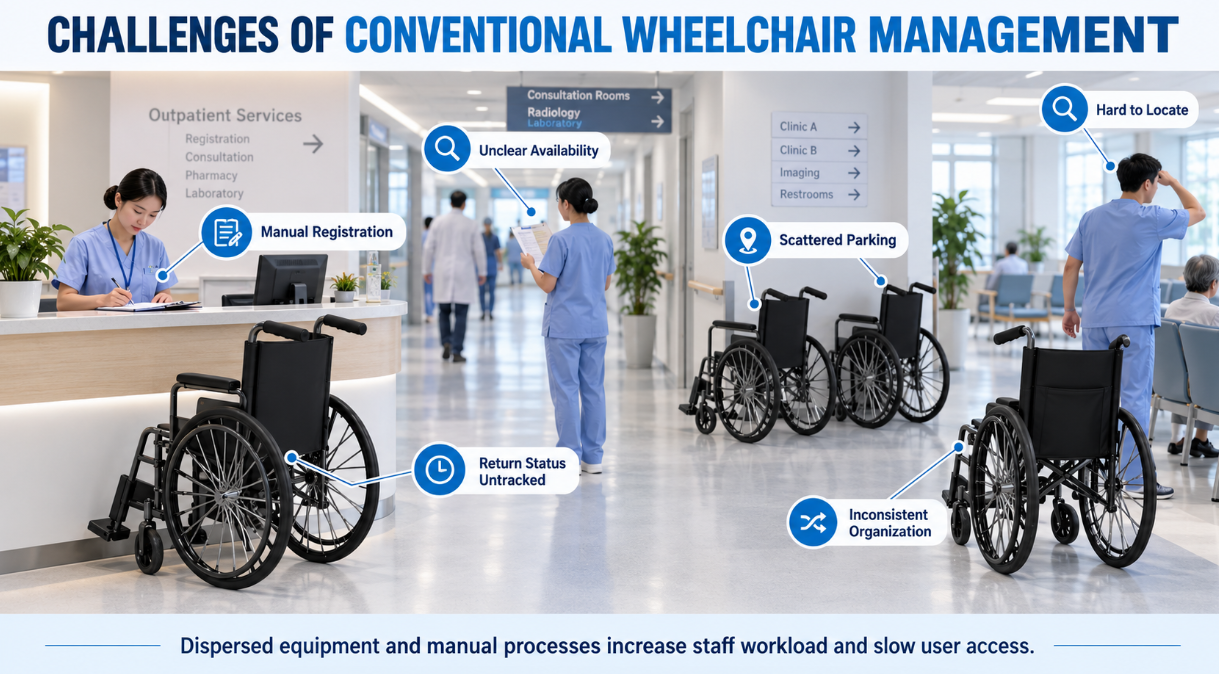
With conventional hospital wheelchair management, loans are often handled through manual registration, deposits, or staff assistance. This approach can create several operational issues:
01 Patients may not know where to find a wheelchair when one is urgently needed
02 Staff must repeatedly register, verify, and hand over wheelchairs
03 Wheelchair availability and usage status are difficult to track in real time
04 Wheelchairs may be left in undesignated areas, increasing retrieval and repositioning work
05 Extended use and incomplete returns can be difficult to trace
06 Wheelchairs of different sizes and configurations can be difficult to manage in a consistent way
How will users locate the station? How will they check out a wheelchair, identify the correct docking position, and complete a return? How will hospital personnel monitor equipment status?
Only after these real-world workflows were mapped could the team define the required functions, physical architecture, and user interaction logic.
SECTION 02
Turning Broad Requirements into a Clear Product Definition
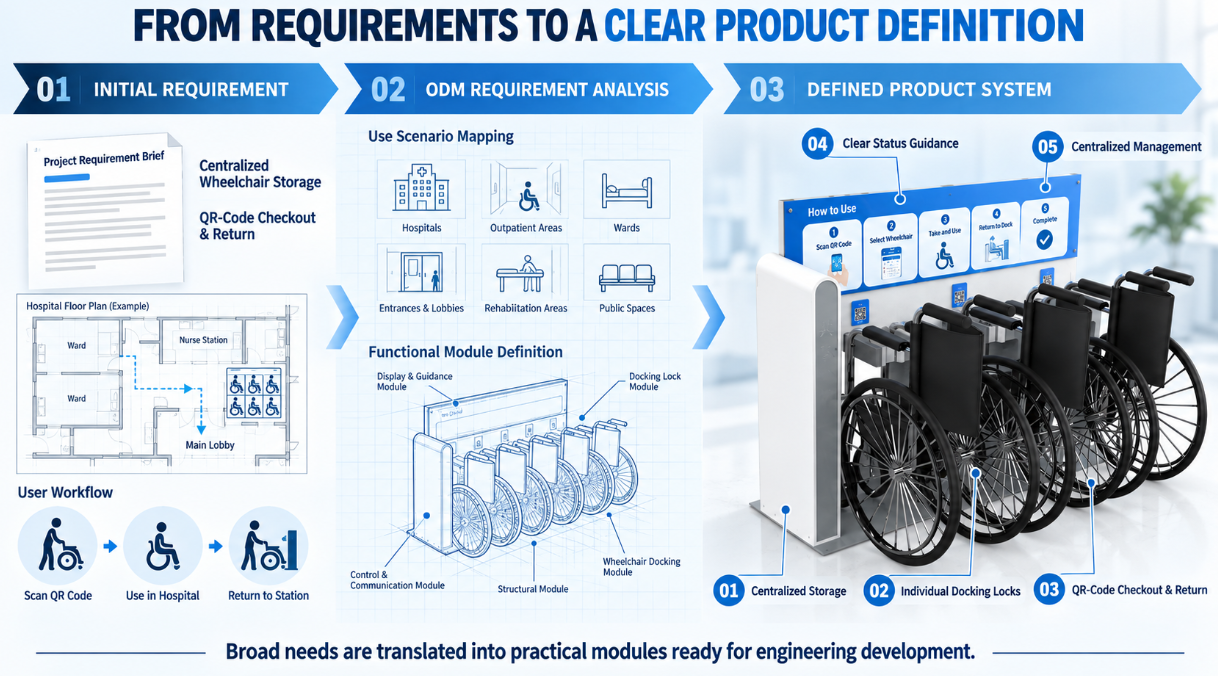
Hospital use cases were translated into practical, buildable product modules.
Working closely with the customer, the team at Dongguan Vision Technology Co., Ltd.
(Vision Technology) refined the project requirements and organized the product into five core functional modules
01
Centralized Storage
Multiple wheelchairs can be parked neatly in a designated area, reducing obstruction in hospital corridors and public spaces while helping patients locate available equipment quickly.
02
Individual Docking Locks
Each wheelchair bay has an independent locking point, enabling individual checkout and return without the confusion that can occur when several wheelchairs share a single locking mechanism.
03
QR-Code Checkout and Return
Users follow the on-device instructions and scan a QR code to release the assigned wheelchair, reducing manual registration and staff involvement.
04
Clear Status Guidance
Bay numbers, icons, and step-by-step prompts help users understand the process quickly and reduce the learning curve for first-time users.
05
Centralized Management
The system records wheelchair checkout, return, and availability data, giving operators essential information to support more efficient hospital asset management.
Once these requirements were clearly defined, the broad concept of a shared-wheelchair solution became a practical product specification ready for engineering development.
SECTION 03
Smart Features Matter—but Mechanical Implementation Is the Greater Challenge
A shared-wheelchair docking station combines electronic control and system interaction with a physical structure that must withstand frequent, long-term use.
Electronics determine whether a product is smart; mechanical engineering determines whether it can perform reliably in daily operation. During development, the team focused on four key questions.
01 | How Can the System Accommodate Different Wheelchairs?
Wheelchairs vary by brand and model in frame geometry, wheel spacing, and lower-frame configuration. An overly restrictive docking interface can prevent proper positioning, lead to inaccurate locking, or interfere with checkout and return. The mechanical design therefore had to balance the overall footprint, bay spacing, and compatibility across wheelchair types.
02 | How Can Users Dock a Wheelchair Quickly?
For patients with limited mobility and accompanying caregivers, fewer steps mean a better experience. The station needs clear, intuitive positioning guidance so users can return and secure a wheelchair without repeated adjustments.
03 | How Does the Station Remain Stable?
As users push, pull, and steer multiple wheelchairs into and out of the station, the structure is subjected to repeated forces. The main frame, base supports, and connection points must provide sufficient stability to prevent movement, loosening, or deformation over time.
04 | How Should the Electronic Control Modules Be Integrated?
QR-code scanning, lock release, status feedback, and back-end connectivity all depend on integrated electronic components. These modules must be accessible for installation and servicing, while cables should remain concealed to support safety, cleanability, and a professional product appearance.
SECTION 04
Make the Process Clear—even for First-Time Users
Public-use equipment must deliver more than a complete feature set; it must also minimize barriers to use.
Hospital equipment serves a broad user population. Younger users may be comfortable with QR-code interactions, while older patients, accompanying caregivers, and first-time users often need clearer, more direct guidance.
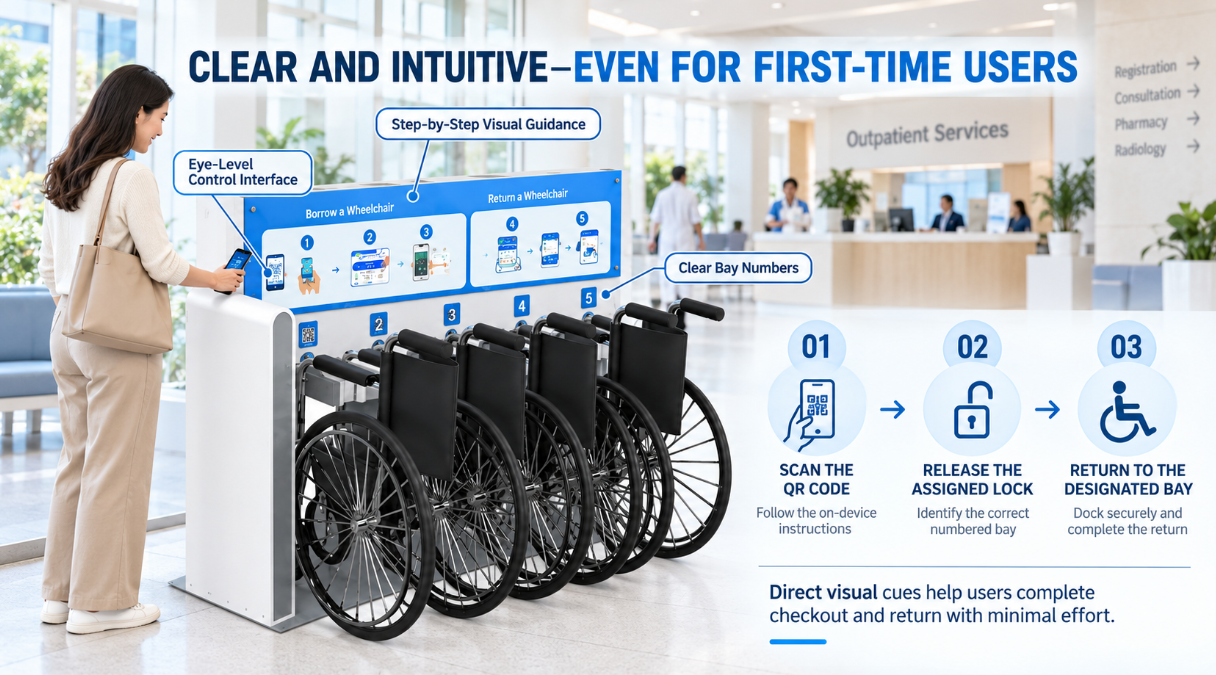
The control area therefore uses clear bay numbers and graphical instructions, creating an intuitive link between each wheelchair bay, locking point, and operating prompt. Users can identify the wheelchair they need and follow the steps with minimal effort.
Scan the QR Code
Release the Assigned Lock
Return to the Designated Bay
The control and guidance interface is positioned within a natural line of sight, reducing the need to bend down, search for instructions, or repeatedly verify each step. A well-designed smart product for a public environment should not require users to study the equipment—it should make each action feel direct and intuitive.
SECTION 05
From a Stand-Alone Product to a Scalable System
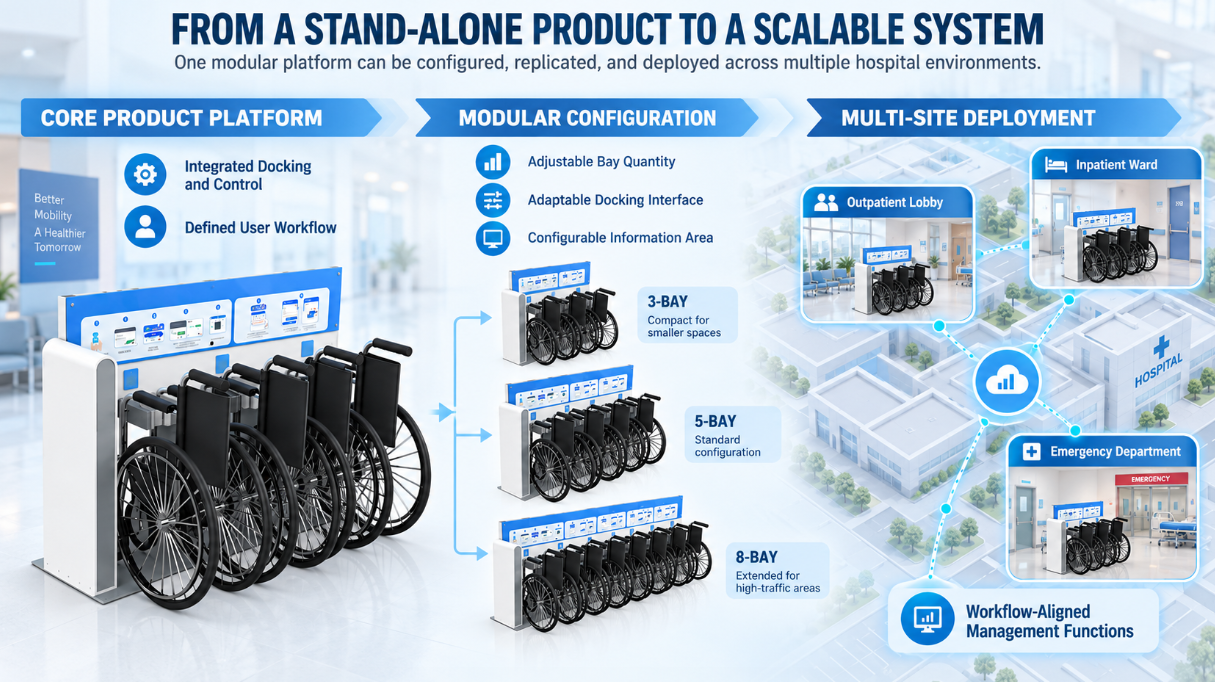
Every hospital has different space constraints, wheelchair volumes, and operating models. Some facilities need a centralized station in the outpatient lobby; others require units in inpatient wards, emergency departments, or on multiple floors. Some projects call for only a few bays, while others require a distributed network across several locations.
A single fixed configuration would require repeated redesign, longer development cycles, and higher manufacturing costs when adapting the product to new sites. For this reason, modularity and customization were addressed during product definition:
✓ Adjust the number of wheelchair bays to suit the available space
✓ Optimize the docking and locking interface for specific wheelchair configurations
✓ Match QR-code and management functions to the operator's workflow
✓ Adapt the enclosure, identification, and information areas to the hospital environment
Allow sufficient access and clearance for installation, transportation, and ongoing maintenance
This approach met the immediate project requirements while creating a platform that can be replicated and scaled for future deployments.
SECTION 06
A Working Prototype Is a Milestone, Not the Finish Line
A functioning prototype does not automatically mean that a product is ready for hospital deployment.
The shared-wheelchair docking system still required repeated validation under representative operating conditions:
✓ Can wheelchairs be docked and removed smoothly?
✓ Do the locking and release mechanisms operate consistently?
✓ Are the operating instructions easy to understand?
✓ Can different users complete checkout and return quickly?
✓ Does the structure remain reliable after repeated use?
✓ Can electronic control components be serviced and replaced efficiently?
✓ After installation, does the station maintain safe clearance for staff, patients, and general circulation?
Through prototype testing and use-scenario validation, the team refined bay spacing, control placement, structural connections, and operational details until the design could perform reliably in its intended environment.
For an ODM manufacturer, the goal is not simply to produce the first working unit. The real task is to validate and refine the design until it is ready for sustained use and repeatable production.
SECTION 07
From Engineering Drawings to Hospital Deployment
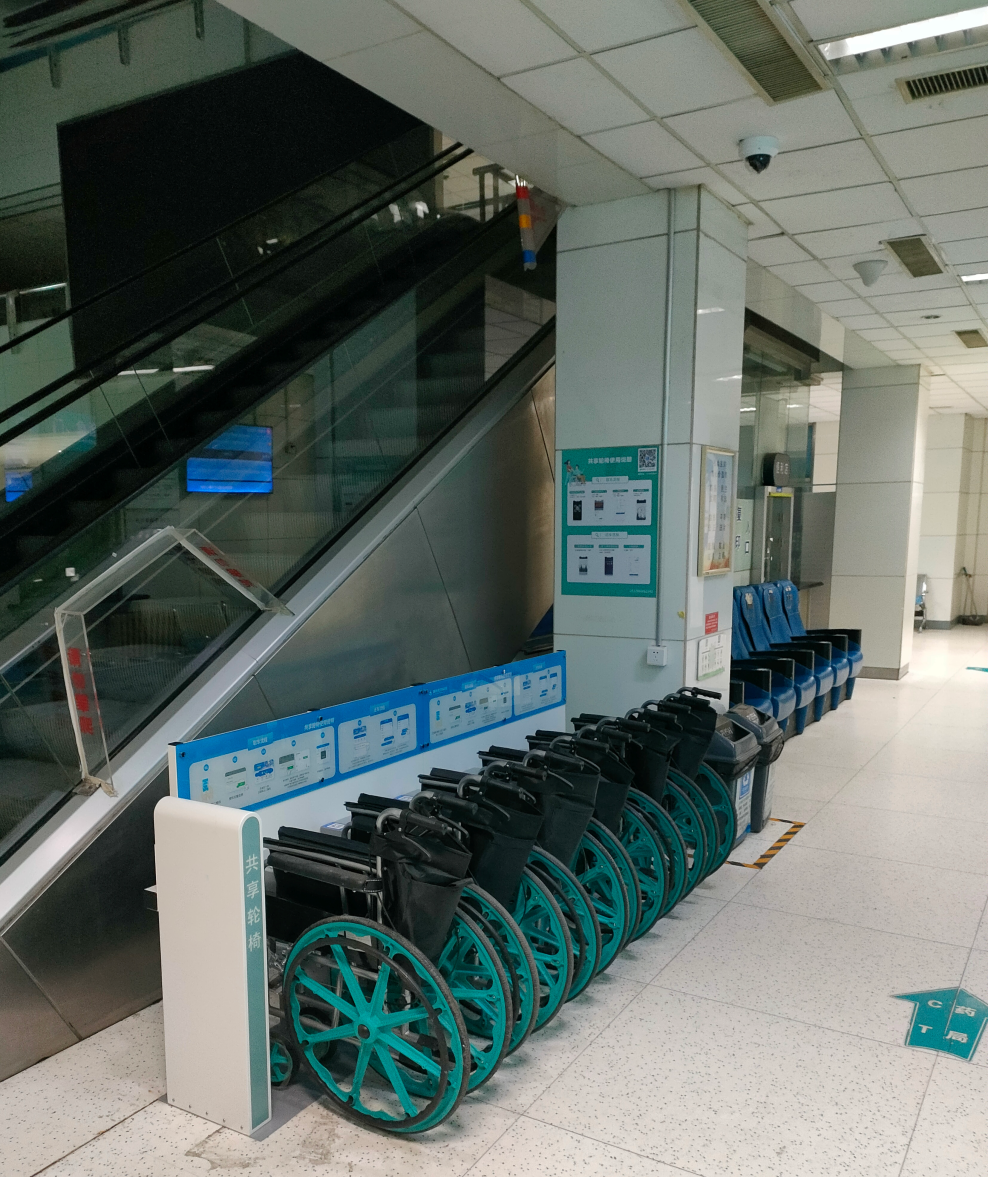
Following product development, prototype validation, and manufacturing, the smart shared-wheelchair docking system was deployed in a hospital environment.
Multiple wheelchairs can now be parked in one designated area, where users follow on-device guidance to complete checkout and return. Hospital personnel spend less time manually registering loans, locating wheelchairs, and reorganizing equipment. Previously dispersed wheelchair assets become visible, orderly, and easier to manage.
Patients
Locate and check out a wheelchair more quickly
Hospitals
Reduce administrative workload and operating costs
Customers
Receive a deployment-ready, operational product
The value of the solution extends beyond adding QR-code functionality. It restructures a conventional wheelchair loan process into a more accessible and manageable hospital service.
For patients, this means finding a wheelchair more quickly when assistance is needed. For hospitals, it means reducing routine management work and improving utilization of shared equipment. For the customer, it means turning an initial concept into a product that can be manufactured, deployed, and operated at scale.
THE VALUE OF ODM
How an Idea Becomes a Deployment-Ready Product
The value of an ODM project goes far beyond simply building to a customer-supplied drawing.
In many cases, the customer begins with an idea, a requirement, or an unresolved challenge from a real use environment. The ODM team's role is to understand the workflow behind that need and translate it into a product definition, mechanical architecture, electronic functions, prototype validation plan, and manufacturing solution.
Turning a customer's initial request into a smart shared-wheelchair system operating in a hospital requires continuous coordination across design, engineering, and manufacturing.
At Vision Technology, we believe that valuable ODM support is not simply about manufacturing a product. It is about helping customers transform an idea into a solution that works in the real world.
ONE-STOP ODM / OEM
Vision Technology | One-Stop ODM/OEM Solutions
From product planning, industrial design, mechanical engineering, and electronics integration to tooling, injection molding, sheet-metal fabrication, surface finishing, assembly, testing, and finished-product delivery, we support the complete product lifecycle.
Product Definition
Engineering & Manufacturing
Finished-Product Delivery
Vision Technology
Medical Equipment OEM/ODM Solutions Provider
Mechanical Engineering · Electronics Integration · Prototype Validation · Volume Production
Submit a request
Your name*
Mail*
Company Name*
phone
message*
File/Image Upload
Note:Up to 6 files, each within 10MVerification code