

How Does a Truly Clinical-Ready Endoscopy Cart Come to Life?
As endoscopic systems continue to evolve, medical carts are no longer simple “carriers.” They have become a critical component that directly affects examination efficiency, physician workflow, and equipment safety.
Through long-term collaboration with multiple endoscopy equipment manufacturers, we have learned that the true value of a solution is not defined by how impressive it looks in renderings, but by whether it can operate reliably, stably, and efficiently in real clinical environments over the long term.
This is the core logic behind our focus on endoscopy medical cart ODM/OEM services:
starting from real clinical scenarios, and turning concepts into solutions that truly work in practice.
01.Why Is This Cart Solution Chosen Again and Again?
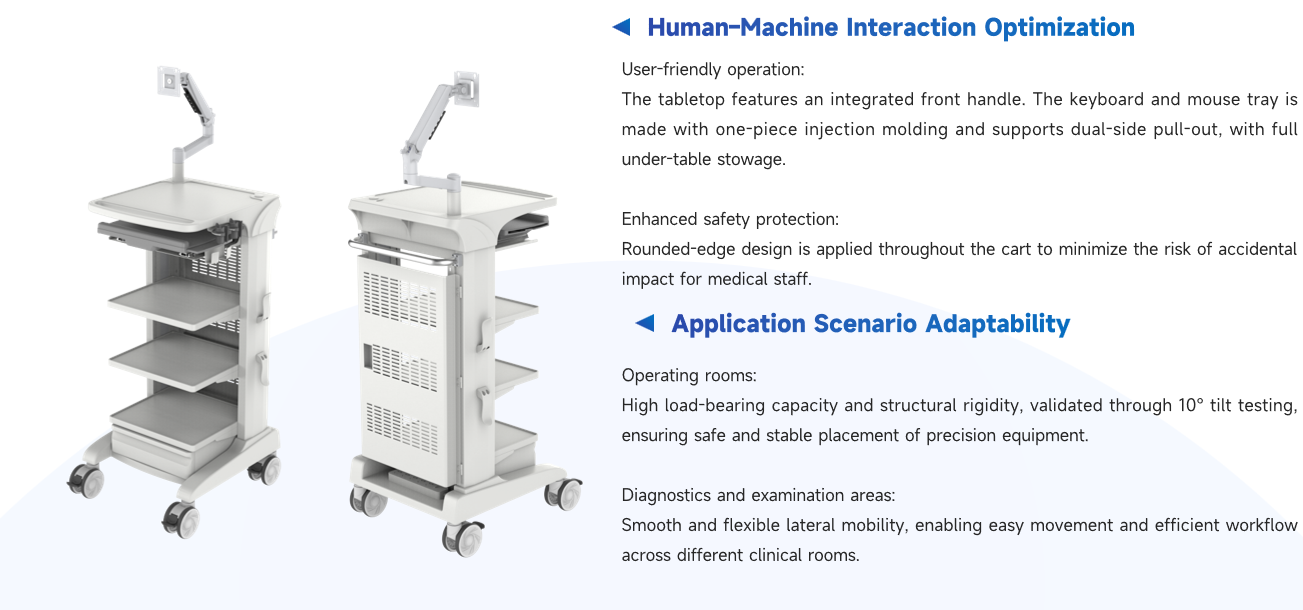
1)Not Just Stored — Ready When Needed.
In clinical practice, what frustrates physicians most is often not the number of devices, but disorder, congestion, and poor accessibility.
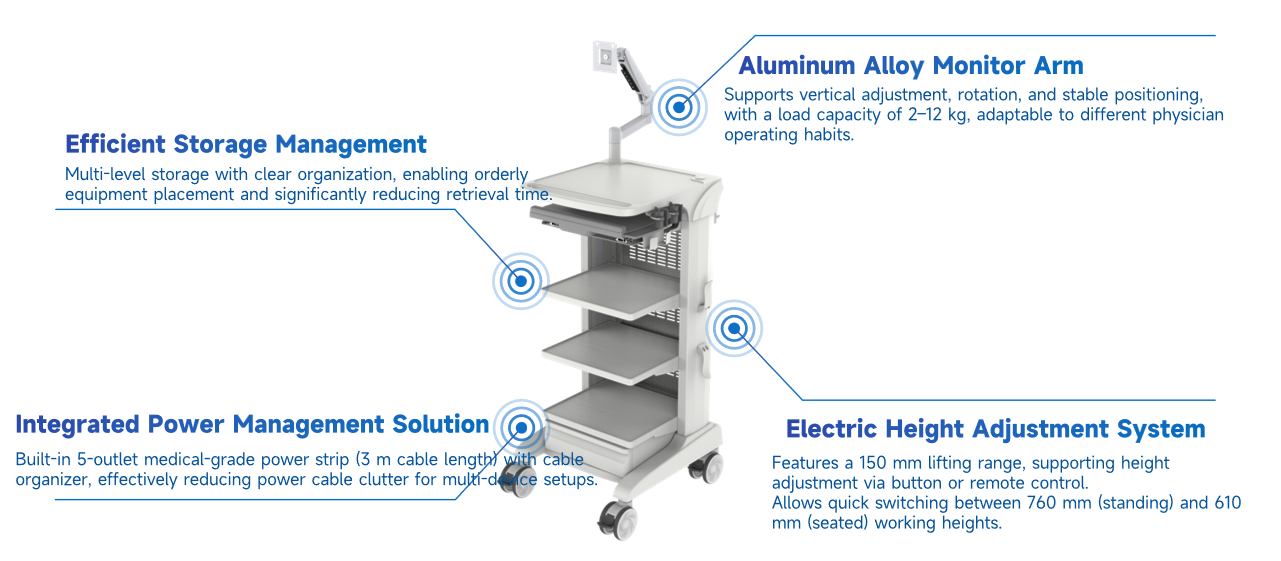
Multi-level, classified storage design
Core units, monitors, scopes, and power modules are clearly separated and positioned, avoiding clutter and stacking. This reduces retrieval time and streamlines the examination workflow.
Drawer-based structural design
Small instruments, accessories, and consumables are centrally stored, significantly improving space utilization while making daily inventory checks and department management easier.
✅ Feedback from multiple customers confirms that per-examination preparation time has been noticeably reduced—a key reason why these solutions continue to be reordered.
2)Designed for Doctors, Not Machines.
Adjustable monitor arm
Supports vertical adjustment, rotation, and stable positioning, with a load capacity of 2–12 kg (optional configurations). Designed to adapt to different physician preferences and patient positioning.
Ergonomic keyboard tray
Dual-sided pull-out design with full under-desk stowage, keeping the working area clean and organized while reducing visual and operational distractions.
Medical-grade silent casters
Smooth and flexible mobility with low-noise operation, suitable for seamless movement across outpatient clinics, examination rooms, and operating rooms.
✅ These details are not the result of one-time design decisions, but of continuous iteration based on multiple rounds of real-world clinical feedback.
3)Safety and Durability: The Invisible Threshold for Hospital Adoption
High-strength aluminum alloy column with rack-and-slot structure
Enables flexible tray height adjustment while maintaining long-term stability, with no sinking or deformation during extended use.
ABS injection-molded base cover with bottom counterweight
Validated through 10° tilt testing and 50 km rolling tests, ensuring smooth movement and stable positioning without wobbling.
Rounded-edge protection and overall safety design
Reduces the risk of accidental impact for medical staff and aligns with hospital safety management standards.
✅ These structural designs and validation standards have become critical supporting factors for multiple customers in regulatory inspections and tender evaluations.
02.More Than Customization — Solutions Built for Repeated Deployment
This cart solution is not a one-off, isolated customization, but is built on a modular design system that supports scalable production, continuous iteration, and rapid delivery:
Component Introduction
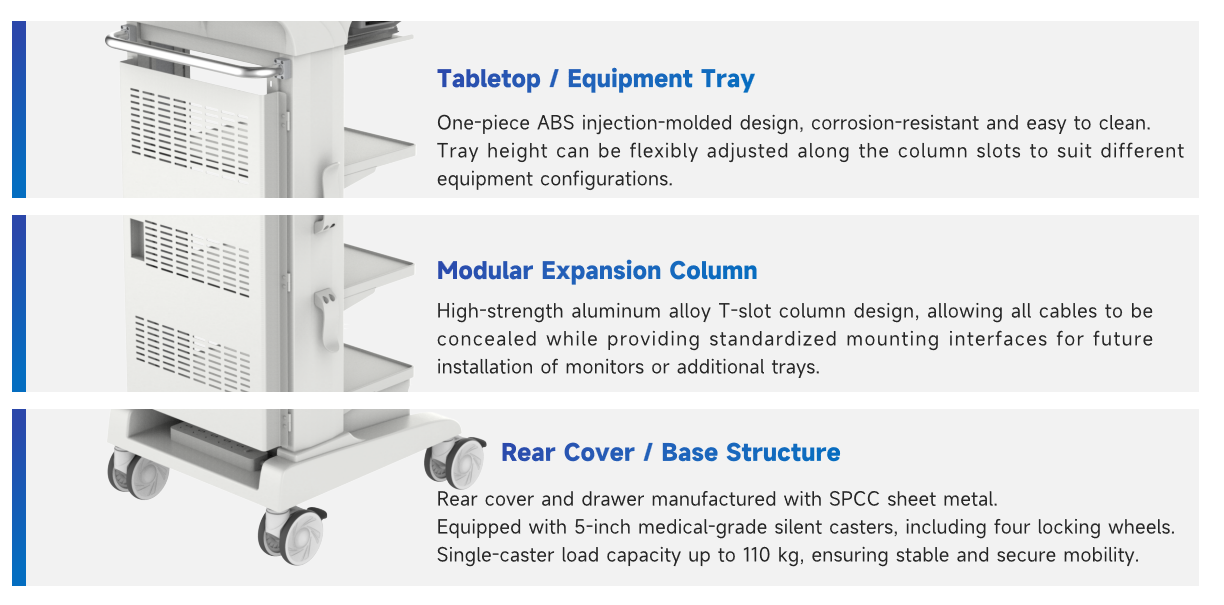
Injection-molded integrated tabletop with front handrail
One-piece molding design with an integrated front handrail, enhancing structural strength and daily operational convenience.
Three-tier equipment tray system
Compatible with multiple endoscopy system configurations, supporting flexible equipment combinations across different models.
Column-integrated cable management system
Includes hidden cable channels, a cable organizer, and a 5-outlet medical-grade power strip (3 m cable length) to keep wiring organized and compliant.
Rear hinged cover design
Allows easy access for equipment wiring, inspection, and long-term maintenance.
For our customers, this means:
✅ Rapid adaptation to different equipment models
✅ Consistent quality across batch production
✅ Future upgrades without structural redesign
03.Real-World Implementations
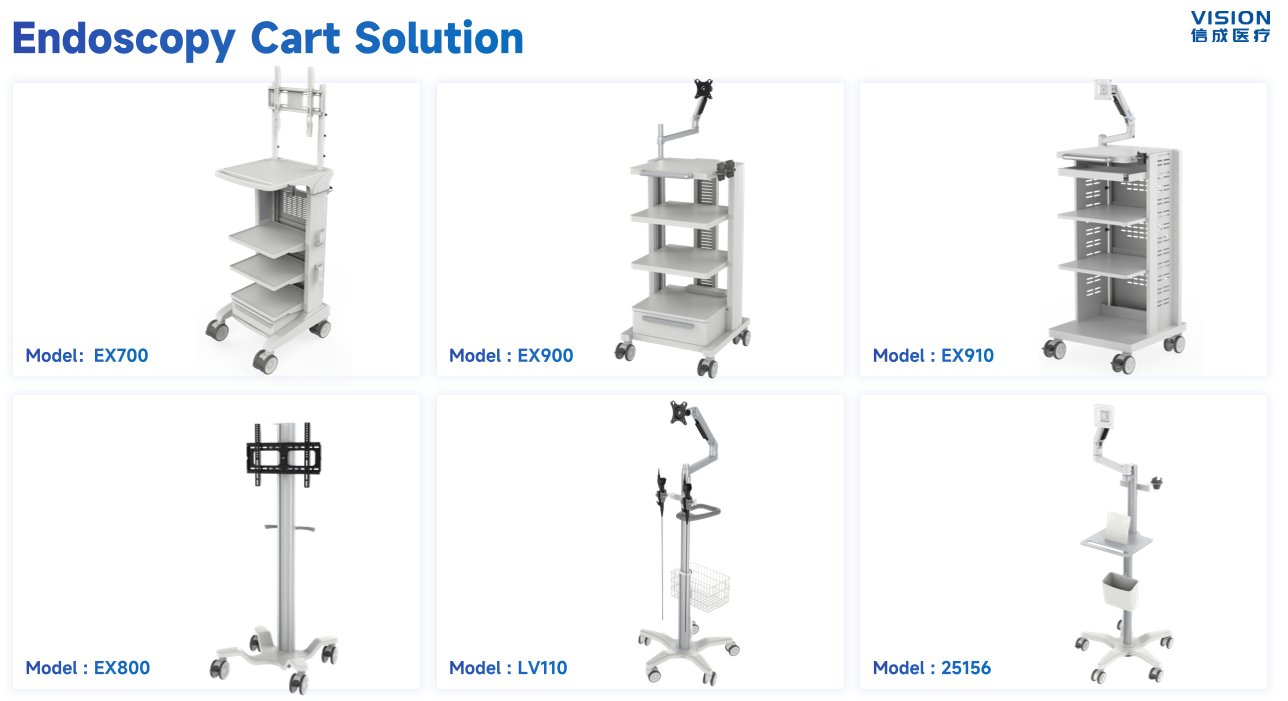
Most of the solutions shown have already been adopted by multiple domestic and international endoscopy and medical device manufacturers (shown here under anonymized project codes for confidentiality).
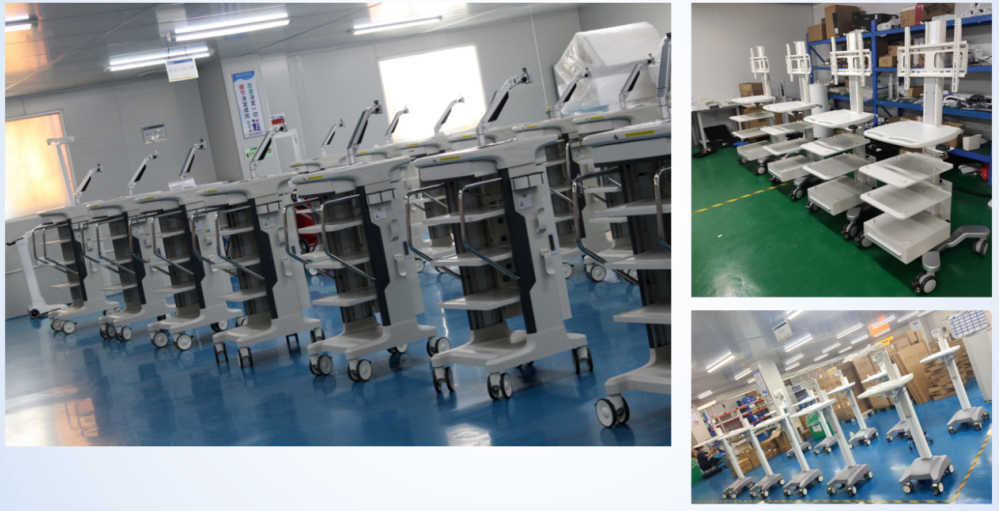
Designed for integrated endoscopy solutions, with a strong focus on structural stability and consistency in mass production.
Strict requirements on ergonomic design and aesthetic quality, ensuring the solution aligns with the positioning of high-end imaging equipment.
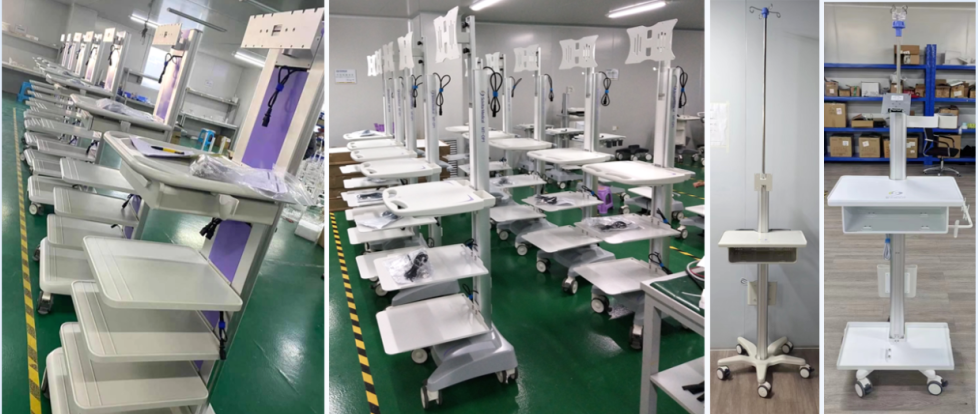
Validated through repeated use across multiple clinical departments, with a strong emphasis on durability and mobility performance.
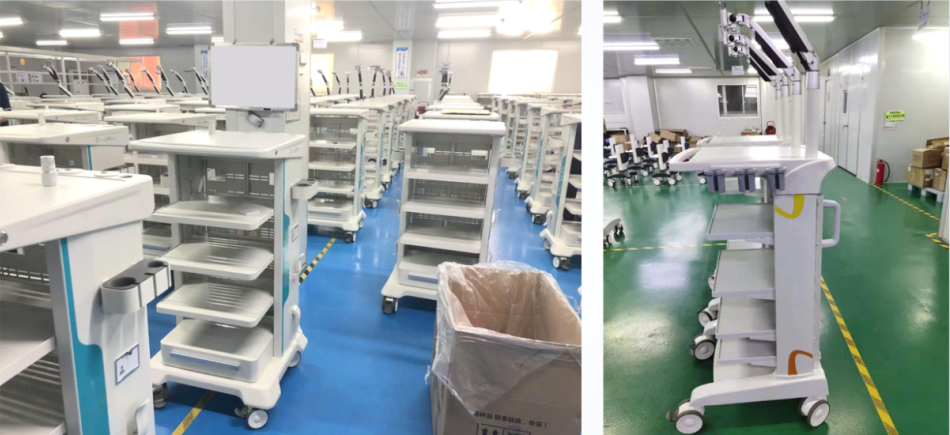
Designed for export-oriented projects, with clearly defined requirements for testing standards, materials, and manufacturing processes.
What these partnerships have in common:
✅ They are not one-time trials, but are integrated into long-term product line collaborations.
04.Beyond the Cart: Comprehensive ODM / OEM Capabilities
From requirement analysis and structural design, to injection molding and metal fabrication, and through assembly, testing, and final delivery, we remain focused on one core objective:
to ensure that endoscopy equipment operates stably, efficiently, and safely in real clinical environments.
If you are looking for:
● Endoscopy cart solutions designed for long-term mass production with consistent quality
● An ODM/OEM partner that can evolve alongside your equipment roadmap
● A team that truly understands both clinical requirements and manufacturing execution
Then this cart solution—already validated by multiple customers—may be exactly what you need.
Rooting professional design in real clinical scenarios.
We welcome collaboration to create medical equipment solutions that truly fit clinical practice.
Submit a request
Your name*
Mail*
Company Name*
phone
message*
File/Image Upload
Note:Up to 6 files, each within 10MVerification code